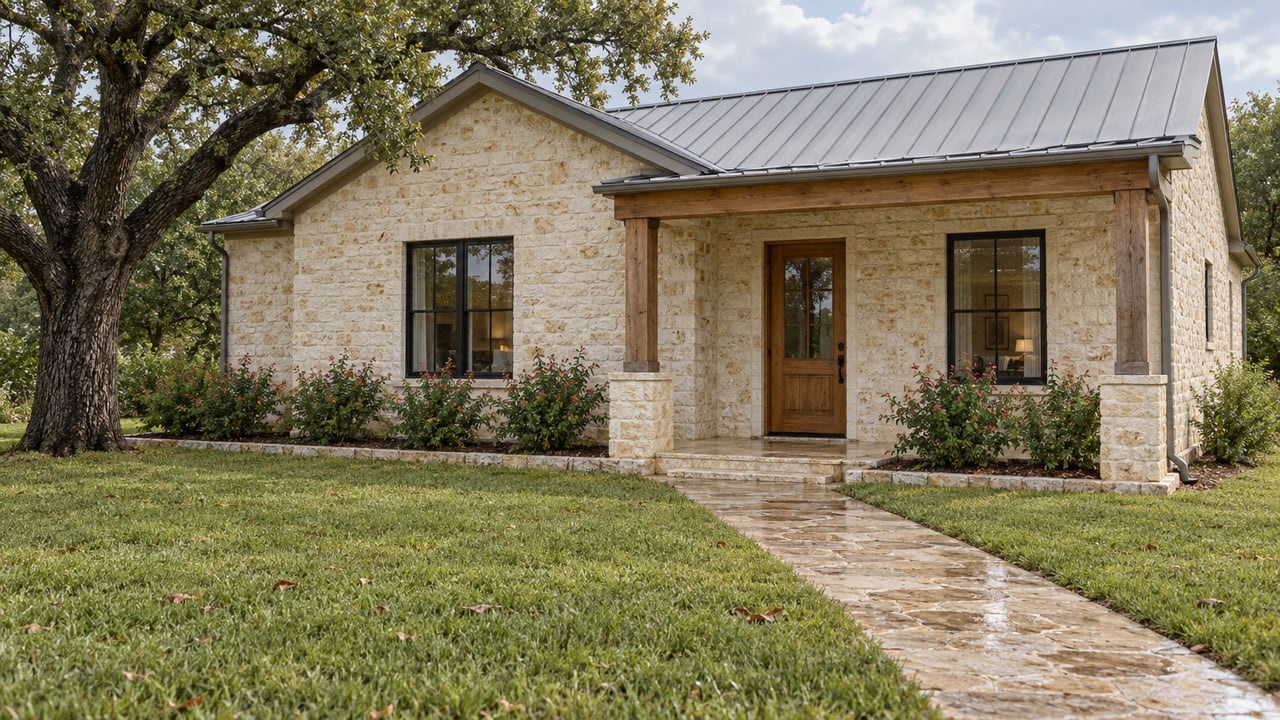
At its Oct. 20 meeting, Fredericksburg City Council considered a request about 708 Whitney Street, a house known as Lykke House. The owners wanted it rezoned from residential to commercial. According to the Fredericksburg Standard-Radio Post, their attorney, Robert Schwing, said the owners wanted to recover what they had put into buying and maintaining the house. He told council the house had historically been used as a short-term rental, that three other short-term rentals operate nearby, and that the Herb Garden, a commercial property, sits about two blocks down the street. He also said the owners would limit business hours to keep evening traffic down.
Council voted 5-0 to deny the request, in line with the Planning and Zoning Commission.
The house's rental history, the nearby rentals and the commercial use down the street all failed to win the vote. That matters to anyone pricing a Fredericksburg house partly on what it could earn as a nightly rental. A house's ability to rent nightly depends on its zoning district, a one-year permit and a filing the new owner has to make after the sale. In some districts, that filing has a deadline counted from the closing date.
Why council could not rezone with conditions attached
The owners offered limits on business hours. Development Services Director Clifton Cross explained why limits like that don't work, as reported by the Standard: "Once you rezone it to an underlying zoning district, you cannot do contract zoning. Everything that's permitted by right is still permitted by right once you do the underlying zoning. So you cannot place uses in there or remove uses that are permitted by right."
That is the incentive behind the vote. Rezoning one house to commercial so it can rent nightly would also bring every use the commercial district permits by right, and conditions could not take those uses away. Mayor Randy Briley said he wanted to keep the residential zoning and avoid a domino effect of commercialization. So for a house in a residential district, this vote shows how hard it is to use rezoning to rescue a rental use.
A sale restarts the permit paperwork
This is where buyers get caught off guard. The city's short-term rental ordinance, which took effect Jan. 1, 2024, assigns each rental a permit number that stays with the property through ownership changes. That permit lasts one year, and renewal comes with an inspection. A renewal application that arrives after the permit has expired is treated as a brand-new application.
What happens at a sale depends on the property's zoning:
- In districts where short-term rentals are allowed by right, the new owner can take over the permit by filing a complete permit application before starting to rent under new ownership.
- In districts where the use is no longer allowed by right, the rental is a nonconforming use. The new owner must file a new permit application within the voluntary-discontinuance period set by Section 6.110 of the zoning ordinance, counted from the closing date. If that window passes without a filing, the rental use must stop, and the permit can't be transferred or reissued.
- Buying through an entity triggers a transfer too. Moving more than 50% of the ownership interest requires a permit transfer, including a transfer of interest in an LLC or other legal entity that owns the rental.
- A change of ownership also brings an inspection, in addition to the inspections at first permit and at each renewal.
Before filing a permit application, the ordinance also requires operators to contact the City Finance Department. Operators must also remit the hotel occupancy taxes that apply in a timely manner. On the state side, the Texas Comptroller sets the state hotel occupancy tax at 6% of the room cost. According to the Comptroller's hotel tax FAQ, when a booking platform collects and remits that state tax, the owner doesn't remit it for those bookings. When the platform doesn't, the owner does.
The ordinance also says all permits issued under it are public information under the Texas Public Information Act. So a listing's description and a property's permit record are separate things, and the permit record is the one the city enforces.
Each district allows different kinds of rental
The ordinance sorts short-term rentals into four types. An STR-unoccupied rental is any short-term rental in a lawful residential dwelling that isn't an STR-ADU or an STR-B&B, which covers the whole-house rental most buyers picture. An STR-B&B is a rental on a property where the owner, operator or 24-hour contact lives as a principal residence, with up to four separately permitted bedroom units. An STR-ADU is a rental in an accessory dwelling unit, where the main house is the owner's homestead or the 24-hour contact's primary residence. An STR-facility is a complex of up to eight units, owned or operated by a single owner or operator, on one lot.
Here is where each type is allowed under the zoning table in Section 4.400:
| Rental type | Allowed by right | Residential exception |
|---|---|---|
| STR-unoccupied, no one living on site | C-1, C-1.5, C-2, CBD, MU-1, MU-2 | R-1 and R-2 by special exception only |
| STR-B&B, owner or contact on site | R-1, R-2, C-1, C-1.5, C-2, CBD, MU-1, MU-2 | None needed in those districts |
| STR-ADU, accessory unit | R-1, R-2, C-1, C-1.5, C-2, CBD, MU-1, MU-2 | None needed in those districts |
| STR-facility, up to eight units | C-1, C-1.5, C-2, CBD, MU-1, MU-2 | Not allowed in residential districts |
No type of short-term rental appears in the table for R-1-A, R-3, R-4, R-5, Rural Residential, the industrial and M districts, OS or PF. A planned unit development can allow the use if its own terms list it as permitted.
Two houses on the same street can have very different futures as rentals. In R-1 or R-2, a buyer who plans to live in the house and rent bedrooms or a guest unit is using an allowed type. A buyer who plans to rent the whole house while living somewhere else needs a special exception.
The special exception has a narrow test
The Zoning Board of Adjustment hears those special exceptions. To allow an STR-unoccupied rental in R-1 or R-2, the ordinance requires both of these:
- The property shares two or more lot lines, or one for a corner lot, with properties that are either lawfully operating as STR-unoccupied rentals or zoned CBD, C-2 or PF. PF lots with public primary or secondary school uses don't count.
- More than half of the properties within a 200-foot radius meet the same standard.
Even when a property meets both conditions, the board can grant an exception only if it finds the rental won't hurt the value and use of neighboring property or go against the public interest. It may weigh things like lot size, noise and whether the use fits the surrounding area.
The test turns on what the neighbors' lots are. It doesn't look at the house's own history. So a residential lot surrounded by long-term homes can't qualify, however long it once rented to guests. The city's January 21, 2026 Zoning Board of Adjustment agenda shows these requests come up case by case. That agenda included a request for an STR-unoccupied permit at 209 North Elk Street.
A permit still has limits in a commercial district
On Oct. 20, council also approved a conditional use permit to expand a commercially zoned rental at 223 West Street. A neighbor had protested, worried that more beds would make parking worse. According to the Standard, the contractor said the project adds no bedding. It renovates an existing garage that holds the washer and dryer, adds a bathroom and wet bar near the pool and hot tub, and adds off-street parking the property didn't have.
Council asked how the city would confirm that no beds were added. Cross said the only way is to watch future advertising, and the Standard reported a 4-1 vote to approve.
Advertising matters because the ordinance caps occupancy and requires parking:
- Occupancy is two guests per bedroom plus two more, with a cap of 12 people.
- Parking is one on-site space for each bedroom operating as a rental. Guests can't park on unimproved surfaces.
Going above either limit takes a special exception. For a buyer, a house's earning power as a rental is tied to its bedroom count, its parking and its zoning, and an advertised guest count can't go past what the permit allows.
The rules are being rewritten
Fredericksburg is combining its development ordinances into a single Unified Development Code. The city's request for qualifications put the overall project at roughly 18 to 24 months. The city announced a public kickoff for Aug. 12, 2026, with Development Services staff and consultants from Kimley-Horn. On Oct. 20, council approved a Texas General Land Office grant contract for the Unified Development Code, according to the Standard.
State law leaves the city's authority in place. House Bill 2464, passed in 2025, says the state's home-based business law "does not prohibit" a city from adopting or enforcing an ordinance "regulating the operation of a short-term rental unit."
The number of permits has been moving too. The city's FY2025 budget reported 922 permitted short-term rentals during 2024, down from 959 at the end of FY2023. Until a new code is adopted, the ordinance in effect since Jan. 1, 2024, is the rulebook a buyer is working with.
Questions buyers ask about this
Does a house that rented nightly for years keep that right after a sale? Under the ordinance, that depends on the zoning district and on the new owner filing a permit application in time. In districts where the use is no longer allowed by right, the filing window starts at closing.
Can I rent out part of a house I live in, in R-1 or R-2? The zoning table allows STR-B&B and STR-ADU rentals by right in R-1 and R-2. Both require the owner or a designated contact to live on the property.
What if the house is owned by an LLC and I'm buying the LLC? A transfer of more than 50% of the ownership interest in an entity that owns the rental also requires a permit transfer.
This post is general information about the city's published rules, not legal, tax or financial advice. Please confirm your own property and plans with a real estate attorney, a tax professional and the City of Fredericksburg.
If you're looking at a Fredericksburg house with nightly rental income in mind, Krista Duderstadt can help you check its zoning district, permit status and transfer timing before you make an offer. If you're thinking of selling a permitted rental, she can help you plan the sale around those same rules. Schedule a free consultation and start with the zoning.