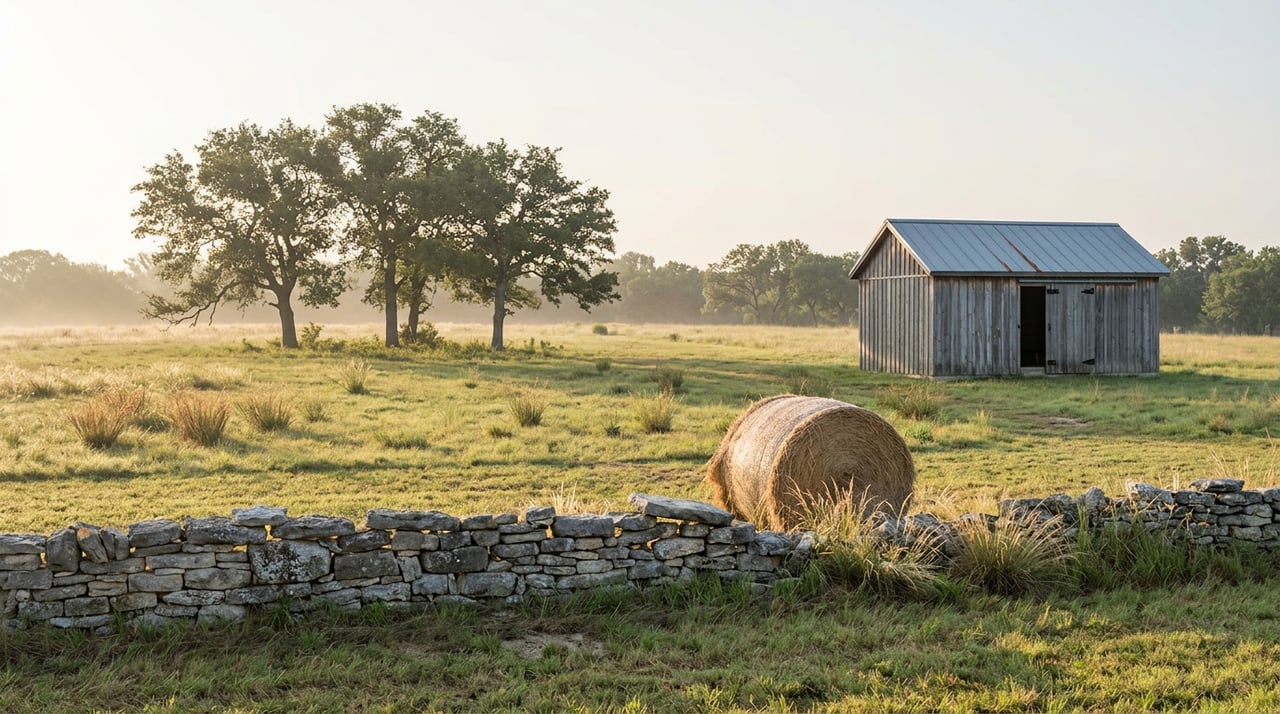
The tax line on a Hill Country land listing is often the number that closes the deal. A tract priced in the hundreds of thousands of dollars can carry an annual property tax bill of a few hundred dollars, and that gap is the entire reason Texas built its agricultural valuation system in the first place. The number is real. It is also temporary, and Gillespie County has the paperwork to prove it.
What the listing calls an "ag exemption" is not an exemption at all. It is a special valuation under the Texas Constitution's 1-d-1 open-space provision, and it lets qualifying land get taxed on what it produces rather than what a buyer would pay for it. The low bill belongs to the current use of the land, not to the land itself. Change the use after closing and the county can reach back and collect the difference, plus interest. For acreage buyers near Fredericksburg, that difference has never been worth more than it is right now.
What the Low Number Is Actually Measuring
The gap between productivity value and market value is the entire mechanism, and Gillespie County sets its own standard for what counts as active use. According to a Gillespie Central Appraisal District presentation by Chief Appraiser Scott Fair, the district typically requires one animal unit for every 20 to 25 acres of native range, with a minimum operation size of two animal units. That is the bar a buyer inherits along with the low tax bill, and it has to keep being cleared every year the valuation stays in place. The district's published ag use standards lay out the fuller picture, including how leases, wildlife plans, and beekeeping can also qualify.
None of that is disclosed on a listing sheet in a way most buyers can price. It shows up later, usually from a title company or a tax bill.
The District's Own Math
Gillespie CAD has published a worked example that shows exactly how the arithmetic runs. On a 20-acre tract removed from agricultural use, the district's guidance shows productivity-value taxes of $1.40 per acre against market-value taxes of $26.25 per acre. That is the difference between a full ag exemption and market pricing.
| Per acre | 20-acre tract, annual | |
|---|---|---|
| Ag productivity value tax | $1.40 | $28 |
| Market value tax | $26.25 | $525 |
| Annual difference | $24.85 | $497 |
That $497 annual gap is the number the county claws back when the qualifying use ends, plus interest for each year the land carried the lower valuation.
The Rule Got Gentler. The Land Got a Lot More Expensive.
Here is where most explainers stop short, and where the math actually matters for a 2026 buyer. The rollback rule itself changed. As of September 1, 2019, House Bill 1743 cut the rollback period from five years to three and lowered the interest charged from 7 percent to 5 percent per year, a change documented in Texas A&M AgriLife Extension's legislative recap. Run the district's own $497 annual gap through that updated formula and the total rollback on that same 20-acre tract comes out closer to $1,640, compared with roughly $3,000 under the old five-year, 7 percent rule. On paper, the exposure got cut by nearly half.
Land values did not hold still while the rule softened. The Texas Real Estate Research Center at Texas A&M reported that the Austin-Waco-Hill Country region, the market area that includes Gillespie County, closed the fourth quarter of 2025 at a record $7,911 per acre, up 8.15 percent year over year, with sales volume climbing nearly 11 percent over the same period, according to the Center's Spring 2026 rural land report. Statewide, prices kept climbing into the first quarter of 2026 as well, reaching $5,246 per acre, a pattern the Center's Q1 2026 report describes as resilient even with fewer total transactions.
That is the part the shorter lookback window does not fix. The $497 gap in the district's old example reflects land values from more than a decade ago. On a tract carrying today's Hill Country market values, the per-year gap between productivity value and market value is dramatically larger than $497, since market value itself has climbed toward $7,900 an acre in the surrounding region. A shorter, cheaper lookback applied to a much bigger gap can still land on a bigger total bill than the old rule produced on a smaller one. The rule became friendlier. The exposure did not shrink with it. For anyone buying acreage priced off today's Hill Country market, that is the number worth running before signing, not after.
What Can Be Carved Out, and What Triggers the Bill
A few mechanics decide whether a buyer ever sees this bill at all.
- Buying land with an existing ag valuation does not, by itself, trigger anything. The clock starts only when the qualifying use actually stops.
- A homesite carved out of a larger tract, say two acres of a 20-acre parcel set aside for a house pad, generally only pulls rollback exposure on that carved-out portion, provided the rest of the tract stays in a qualifying use and the appraisal district's records reflect the split.
- Wildlife management valuation is a conversion, not a fresh start. Land has to already carry, or qualify for, an agricultural valuation the year before it switches to wildlife use, and the owner has to file a management plan the appraisal district approves. The Texas Parks and Wildlife Department's private lands program outlines what that plan needs to include.
- Letting fences sit empty or livestock disappear for a season while "figuring it out" can read to the appraisal district as a change of use, even without a single new structure going up.
Who Actually Pays
Rollback liability follows whoever owns the land when the use changes, not whoever owned it when the low valuation was established. That means a buyer who never intended to farm or ranch can inherit a bill triggered entirely by the seller's exit from the land, if the timing lands wrong.
None of this is fixed by statute in terms of who covers the cost at closing. Some sellers disclose the exposure and adjust the price. Some buyers absorb it as part of the deal. Some split the difference. What is not negotiable is whether the county gets paid once a qualifying use actually stops. A title company handling a rural closing will typically require the rollback calculation up front if a change of use is part of the plan, and will coordinate payment through the closing process when it applies.
A Few Straight Answers
Does buying land with an ag exemption automatically transfer the valuation to me? No. The valuation is tied to use, not ownership. A new owner has to keep the qualifying use going, and typically has to file a fresh application with the appraisal district by April 30 of the following tax year to keep the special valuation in place.
If I only want a small homesite and plan to keep the rest in agricultural use, do I still owe rollback on the whole tract? Generally not, as long as the carve-out is documented and the remaining acreage continues to meet the county's stocking and intensity standards. The exposure is typically proportional to the acreage that changes use.
Can I switch straight from a residential-valued lot to a wildlife exemption to lower my taxes? No. Wildlife management valuation only applies to land that already carries, or qualifies for, an agricultural valuation. There is no direct path from market value to wildlife use without that agricultural history first.
Acreage math in Gillespie County rewards buyers who ask the right question before the option period ends, not after the tax bill arrives. Krista Duderstadt has spent more than two decades reading exactly these kinds of details on Hill Country land deals, from stocking rates to rollback exposure to what a listing's tax line actually promises and what it doesn't. If you are evaluating acreage near Fredericksburg and want the real numbers before you write an offer, schedule a free consultation with Krista Duderstadt and get a clear read on what you are actually buying.